AC Repair or Replace? A Bakersfield Homeowner's Decision Guide
Judge age in valley run-hours, not birthdays - Bakersfield systems live harder and shorter lives than national averages suggest.
Read the Guide
Most Bakersfield AC breakdowns are spring findings: tired capacitors, fouled coils, low charge and clogged drains all announce themselves early to anyone who measures.
Problem: Most Bakersfield AC breakdowns are spring findings: tired capacitors, fouled coils, low charge and clogged drains all announce themselves early to anyone who measures.
Solution: Filters monthly, coils rinsed, the condensate drain proven - the homeowner's three tasks cost almost nothing and prevent the commonest failures.
When to call: The first 105-degree week is a census, not a surprise: systems pass it or confess what spring missed.
Bakersfield does not ease into summer; it issues it. Somewhere in May or June the valley strings together its first week above 105, and on the third or fourth afternoon the phones of every AC shop in Kern County light up with the same sentence: it just stopped cooling. Almost none of those systems failed that day. They failed in March - quietly, measurably - and the heat merely published the result. This checklist is how a household moves its failure back to spring, where it is cheap.
And winter is not the mild season the postcards promise. From November into February the Tule fog settles over the valley floor for days - dense, damp and cold - chilling homes, wetting every surface and driving rodents and insects indoors to wait it out. Bakersfield systems are built, or should be, for the heat, the farm, the dust and the fog at once.
A cooling system at 95 degrees is working at partial load; at 110 it is at its design limit, every component at its rated edge simultaneously. The capacitor that starts the compressor has been baking in the sun and losing value since last summer. The condenser coil is wearing last season's dust like a blanket. The refrigerant charge that leaked a pound over winter was invisible at spring loads. Peak heat does not create these faults - it audits them, all at once, in public.
That is why the first heat wave functions as a census: it counts the valley's unmaintained systems with perfect accuracy. The households on the comfortable side of that week are not luckier. They are the ones whose systems were measured in April, when a drifting capacitor is a line item and a fouled coil is a garden hose's worth of work.
The spring tune-up's value is in its measurements. The capacitor and contactor are tested against their ratings - the two parts that fail most in heat waves, replaced in spring for the cost of the part and minutes. Refrigerant charge is verified by pressure and temperature against the manufacturer's chart, not by the hand-on-the-line test that fools everyone. Temperature split across the coil, amp draws on the motors, and the blower's condition are recorded - a set of vital signs your future diagnoses will be compared against.
The water path gets its own moment: the condensate drain is cleared and the safety switch tested, because summer produces condensate by the gallon and a clogged drain in a fog-damp attic becomes a ceiling stain with legalistic timing - usually during the same heat wave, when no one has time for it. Coils are cleaned inside and out as access allows, restoring the airflow every other measurement depends on.
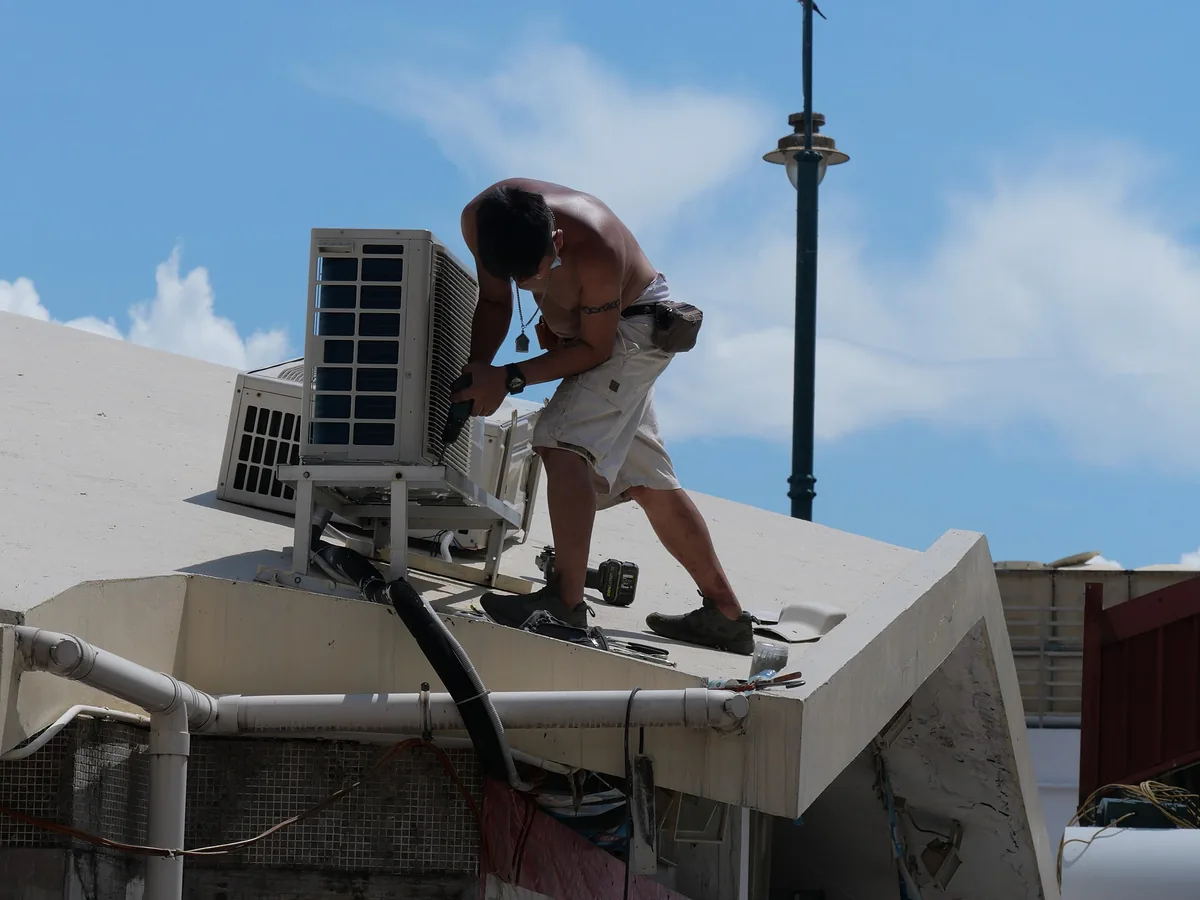

Filters first: in Bakersfield's dust, a standard filter in cooling season is a monthly consumable, not a quarterly one. A loaded filter strangles airflow, ices coils and overworks blowers - it is the simplest component in the system and the cause of a disproportionate share of its serious symptoms. Set the reminder by the calendar and buy them by the case; the discipline matters more than the brand.
Coils second: the outdoor unit's coil can be rinsed gently with a hose when dust mats it - power off, water from inside out where the design allows, no pressure washer ever. Third, the drain: a cup of water poured through the condensate cleanout each spring proves the path before the season's gallons test it. Three tasks, an hour a season in total, aimed precisely at the failure list the heat wave reads from.
A maintained system can still fail - compressors end, boards die, leaks open at new joints. Preparation does not promise a breakdown-free summer; it converts the probable failures into spring findings and leaves only the genuinely random ones for July. It also produces the paper a hard conversation needs: when a seventeen-year-old system finally fails at peak, the maintenance record is what tells the household whether the repair or the replacement is the honest spend.
There is one more seasonal truth: the households with heat plans - a cool room strategy, a relative's spare bed, knowledge of the county's cooling centers - experience even a real breakdown differently. Preparation is partly mechanical and partly domestic, and Bakersfield summers reward both kinds.
The part of the system in the attic suffers the season first: duct insulation baked by a 140-degree space, condensate pans growing the biofilm that clogs drains, and air handlers whose access nobody has cleared since the house was bought. A spring readiness pass includes the attic's honest state - ducts visually sound, drain path proven, access actually passable - because July's repair in an attic that cannot be entered or that floods its own ceiling is a different and worse job.
Insulation and attic ventilation ride along: a house whose attic runs cooler taxes its ducts less, and the household that adds the attic to its spring walk catches the wasp nest in the vent and the duct pulled loose by last winter's storage expedition while both are still anecdotes.
For homes with infants, elders or anyone whose health prices a breakdown as a medical event, readiness includes redundancy planning, not just maintenance: a relative's couch identified in advance, the county cooling centers' locations known, a window unit in the garage as the household's spare tire. The spring conversation with the technician should name the vulnerability plainly - it changes triage priority in a real failure, and the time to establish it is before the failure, in writing, not at 110 degrees by phone.
Medical baseline matters too: heat illness in the elderly can present as confusion attributed to other causes. The household that treats the first heat wave as a drill - checking the vulnerable, watching the house's warmest room - is practicing the same readiness as the coil rinse, at the level where it counts most.
The tune-up's findings have a valley-specific pattern worth knowing: capacitor drift and contactor wear lead, condensate and coil fouling follow, and charge discrepancies trail - except in systems with slow leaks, where charge leads everything. The report you receive ranks your system's findings in that landscape, so a 'watch' item is understood as what it is: next season's probable repair, named while it is still cheap.
That is the service side of this guide's subject. When you are ready, the AC Maintenance & Tune-Up page carries the process, the coverage by area and the number to call.
Spring schedules fill the day the first heat wave is predicted. April's appointment is the same service at a calmer price and pace.
Date each filter as it goes in. In field-edge and construction-adjacent homes, check at three weeks.
Power off, gentle hose, no pressure. Keep plants and fencing a working distance from the unit year-round.
Water through the cleanout, eyes on the discharge point. A slow drain in April is a ten-minute fix; in July it is a ceiling.
Tested against rating at the tune-up - the heat wave's favorite failures, retired in April for the price of the part.
Condenser rinsed, evaporator inspected, airflow proven - the system's breathing restored before it is measured.
Pressures and temperatures against the manufacturer's specification - a pound light is a July limp discovered in spring.
Water through the cleanout, discharge seen, safety switch tripped and reset - the ceiling's insurance, renewed annually.
Scope varies honestly by system in Bakersfield: a swamp cooler household's spring is pads, pump, pan and water path - a different checklist owned by the same season. Heat pump homes add the defrost and staging read while the fog is still recent evidence. The readiness principle survives every configuration: measure in the calm what the heat will test in public, and write the numbers down where next year's visit can find them.
For homes with rooftop packaged units - much of the valley's postwar stock - add the roof itself to the scope: curb seals, the condensate path across the roof, and access safety. Rooftop systems fail at their roof details as often as at their machinery, and spring is when anyone should be up there looking.
The tune-up's professional core is measurement under a standard: charge read against the chart for that day's conditions, electricals against their printed ratings, and findings written as a baseline the next diagnosis can trust. Anyone can rinse a coil; the readiness this guide promises lives in the numbers and the paper they are written on.
Book the professional tune-up when the first warm week is forecast - and immediately if last season ended with any symptom unresolved. The deferred symptom list is the tune-up's agenda, and the only expensive version of it is the one read aloud during a heat wave.
Bakersfield summer is not an emergency that befalls cooling systems; it is an appointment they keep annually, at a published temperature. Readiness is simply deciding which side of that appointment your household stands on - measured in spring, or counted in July.
Judge age in valley run-hours, not birthdays - Bakersfield systems live harder and shorter lives than national averages suggest.
Read the GuideSwamp coolers cool Bakersfield's dry heat cheaply but surrender on humid spells, smoke weeks and the most extreme afternoons.
Read the GuideBecause last summer is exactly what wore it. The capacitor aged through a season of thousand-start weeks, the coil collected a season of dust, and the winter's idle damp worked on everything electrical. 'Worked in September' is a statement about a system that no longer exists; spring measures the one you have now.
The professional measurement of the start components and charge - the failures that strand households in heat waves are concentrated there, and both are cheap to correct in spring. Among homeowner tasks, the monthly filter discipline wins by the same logic.
You can, and the valley's queue in a heat wave will explain the cost: triaged scheduling, hot nights, and a repair made under pressure on a system whose record nobody knows. Waiting is a legitimate budget choice only when the household's heat tolerance - and its heat plan - are honestly equal to it.
Charge measurements want a warm day to read true, so the practical window opens with the first reliably warm weeks. Booking the appointment earlier than that costs nothing; the valley's shops run the list in order as the weather allows.
One call connects you with a local home-services professional serving Bakersfield - pest control and cooling help, matched to your part of the valley.